
 The word epiphany means “manifestation” or “revelation" and is commonly linked in Western Christianity with the visit of the wise men (Magi) to the Christ child.
Customs are unique in different parts of the world, but I'll give you my favorite ones from customs I am familiar with...
~~~
Ireland:
Little Christmas (Irish: Nollaig Bheag) is one of the traditional names in Ireland for January 6, more commonly known in the rest of the world as the Celebration of the Epiphany. It is so called because it was the day on which Christmas Day was celebrated under the Julian calendar, before the adoption of the Gregorian calendar. It is the traditional end of the Christmas season and the last day of the Christmas holidays for both primary and secondary schools in Ireland.

Belgium:
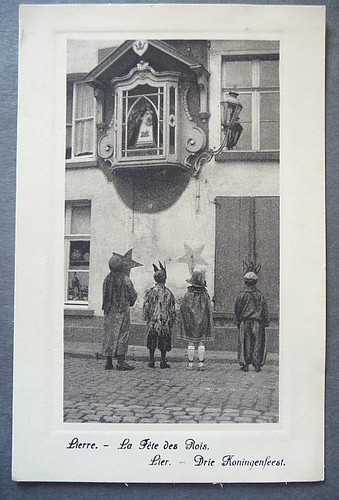 The Dutch and Flemish call this day Drie Koningen, German speakers call it "Dreikönigstag" (Three Kings' Day). In the Netherlands, Belgium, Luxembourg and Germany, children in groups of three (symbolising the three kings) proceed in costume from house to house while singing songs typical for the occasion, and receiving a coin or some sweets at each door. They may each carry a paper lantern symbolizing the star. [26] In some places, especially Holland, these troops gather for competitions and present their skits/songs for an audience. As in France, Koningentaart (Kings' tart), puff pastry with almond filling, is prepared with a bean or coin hidden inside. Whoever finds the bean in his or her piece is king or queen for the day. A more typically Dutch version is Koningenbrood, or Kings' bread. Another Low Countries tradition on Epiphany is to open up doors and windows to let good luck in for the coming year.
 Greece:
In Greece, Cyprus and the Greek diaspora throughout the world, the feast is colloquially called the "Phōta" (Greek: Φώτα, "Lights") and customs revolve around the Great Blessing of the Waters. It marks the end of the traditional ban on sailing, as the tumultuous winter seas are cleansed of the mischief-prone "kalikántzaroi", the goblins that try to torment God-fearing Christians through the festive season. At this ceremony, a cross is also thrown into the water, and the men present clamour to retrieve it for good luck. The Phota form the middle of another festive triduum, together with Epiphany Eve, January 6 (and eve of January 5), when children sing the Epiphany carols, and the great feast of St. John the Baptist on January 7 (and eve of January 6), when the numerous Johns and Joans celebrate their name-day.
In the USA:
There are many customs, but I like the one in Louisiana the best as it segues into my last bit of information on the holiday....
 Epiphany is the beginning of the Carnival season, during which it is customary to bake King Cakes, similar to the Rosca. It is round in shaped, filled with cinnamon, glazed white, and coated in traditional carnival color sanding sugar. The person who finds the doll (or bean) must provide the next king cake. The interval between Epiphany and Mardi Gras is sometimes known as "king cake season", and many may be consumed during this period.
The Carnival season begins on King's Day (Epiphany), and there are many traditions associated with that day in Louisiana and along the Catholic coasts of Mississippi, Alabama, and Florida. King cakes are first sold then, Carnival krewes begin having their balls on that date, and the first New Orleans krewe parades in street cars that night.
And, as a heads up to all of you out there, mark your calendars for making party plans!!
2011 Greek Carnival Dates
Triodion: Sunday, February 12th
Tsiknopempti or "Burnt Thursday": February 24th
Tsiknopempti Weekend: Friday, February 25th - Sunday, February 27th
Main Carnival Weekend: Friday, March 4th - Sunday, March 6th
Clean Monday: Monday, March 7th
March 9 - Ash Wednesday
April 17 - Palm Sunday
April 21 - Maundy (Holy) Thursday
April 22 - Good Friday
April 24 - Easter Sunday (Western Christianity - Roman Catholic, Anglican Communion, Protestant Churches, etc.)
April 24 - Easter Sunday (Orthodox Christianity - Eastern Orthodox Churches)
40 days before the beginning of Lent, Carnival begins on a Saturday evening with the opening of the Triodion, a book containing three sacred odes. This is a religious moment not generally observed outside of the church itself, so don't expect a sudden party to erupt.
The Friday, Saturday, and Sunday preceding "Clean Monday" usually offer vigorous parties, parades, and traditional events wherever Carnival is celebrated. In larger towns or cities "known" for Carnival, such as Rethimno or Patras, the previous weekend will also be filled with activities.
The last Sunday of the Carnival period is known as "Cheese-eating Sunday" or Tyrofagos as no meat products are allowed at this time. Macaroni is often served on this day. Surprisingly enough, the word "macaroni" is not Italian, but comes from the Greek words macaria or "blessed", and aeronia or "eternal". Thus, "macaroni". The preceding day, Saturday, is a special service for the dead in Orthodox churches, and part of the rites includes the making of grain dishes, probably a survival of the ancient rites of Demeter. Thus, "macaroni".
"Clean Monday" or Kathari Deftera, is the actually the first day of Lent (Sarakosti). While a holiday atmosphere still prevails, the foods consumed are all "pure", without the shedding of blood. But this allows cuttlefish and squid, fish roe, and other items. "Lagana" is a flat bread traditionally served on this day.
"Burnt Thursday" or Tsiknopempti is celebrated eleven days before the start of Lent. The "Burnt" part refers to the grilling of meats, a big part of the celebration of this day. The weekend following "Burnt Thursday" will also have parties and other events; technically, that Sunday is the last allowable day for eating meat and is sometimes called "Meat-eating Sunday". The best Greek restaurants will be crowded on this day - but seafood places are a safe bet to have tables available!
In Greece, Carnival dates are tied to Greek Orthodox Easter, which is usually different from Western Easter. Every few years, both calendars will coincide, this seems to be one of those years!
The most vigorous Carnival partying is on the weekend prior to the end of the Carnival season. This is followed by Clean Monday or "Ash Monday", a generally family-oriented day where, picnics and kite-flying prevail. "Clean Monday" is the last day of Carnival for the Greeks. "Fat Tuesday" does not exist in Greece - Burnt Thursday is its closest parallel.
The Greeks pretty much invented Carnival. Most carnival-related events are connected with the ancient worship of the Greek god of wine and divine intoxication, Dionysus. The processions, costuming, and feasting all derive from ancient ceremonies honoring him and other Greek gods and goddesses, though some claim parts of it, including the carrying of models of ships in processions, date back to similar rites in Ancient Egypt.


![Reblog this post [with Zemanta]](https://lh3.googleusercontent.com/blogger_img_proxy/AEn0k_vmyEGmL9-5KTeKkGx-yUAK8vLtJDDs1bTCfmq122FGu-1gaM8wSFKeaRKi4Ds8RdeXMe1DpAVziwrbeuaz4GnRtOmgAL-CxfTm1TsKu4g-6-WVt8CK-bQpfj12OF27Vcx8uGR8VF2w_ratopH1P14U=s0-d)


![Reblog this post [with Zemanta]](https://lh3.googleusercontent.com/blogger_img_proxy/AEn0k_uSBV-uDKCkplTqYW9kfoiODB1P8DzFtT4uZ1Qwelk4pAVlGwJZKvmCIj8AmHn5gc3FE4w9yYZ0BzIaV3bb46-X6VcWhC6nL7faVjd2hhTivqReYrY7c9uFLl2mVkAZwiLT-xG8uJQEktAFm4nPxOVc=s0-d)
